

Table of Contents
Asia’s financial technology market has entered a more demanding stage. Digital payments, artificial intelligence, mobile banking, alternative lending, open finance, and tokenised assets continue to expand, but businesses are now expected to prove that their ideas can produce secure, compliant, and sustainable results.
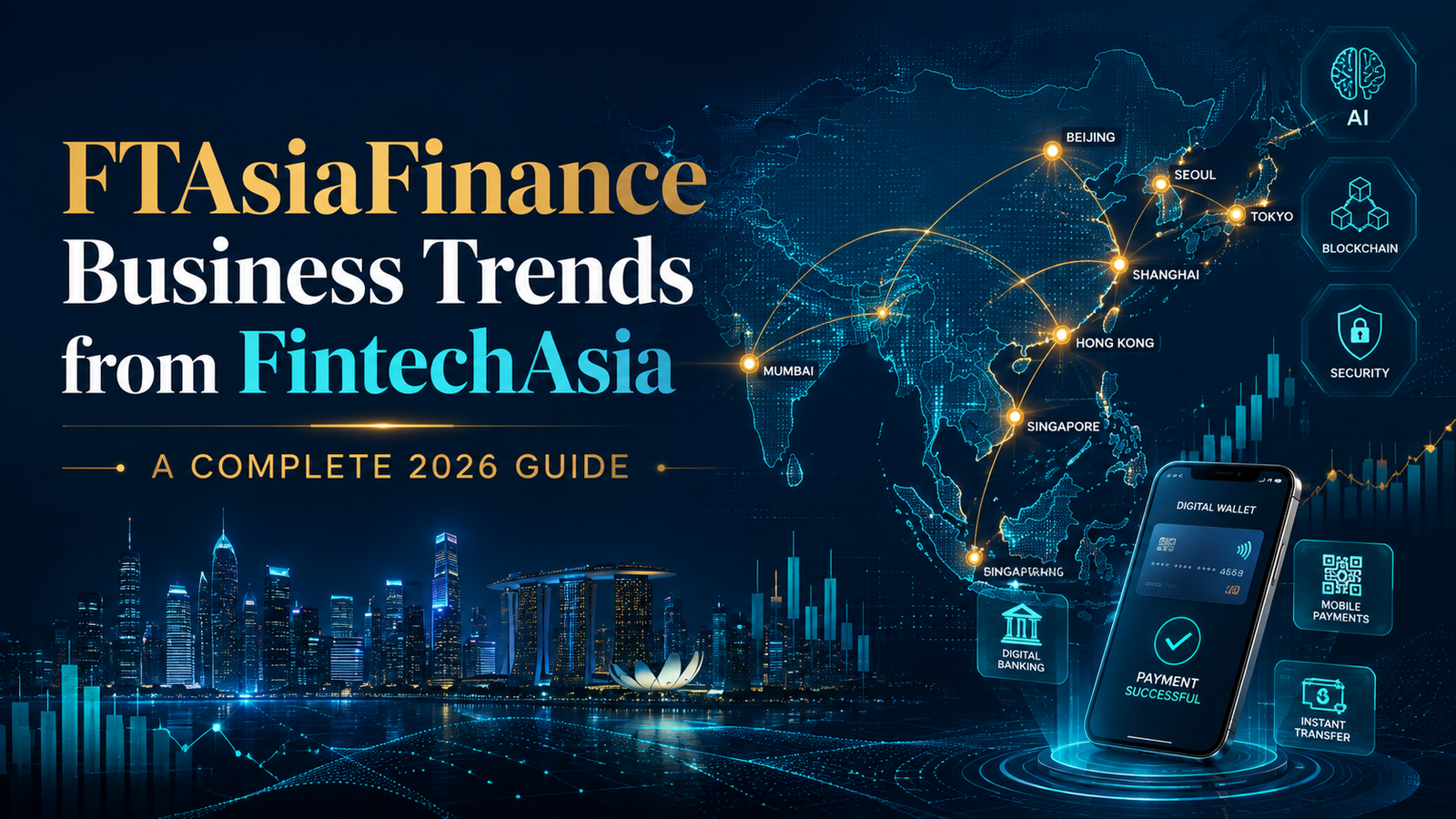
The keyword ftasiafinance business trends from fintechasia reflects growing interest in these changes. Readers using the phrase are generally looking for insights into financial innovation, Asian markets, digital banking, investment conditions, and the technologies influencing how companies manage money.
FTAsiaFinance presents the phrase as part of its business and financial-technology coverage. FintechAsia also publishes content around Asian finance, technology, payments, market developments, and business strategy. These pages are better understood as editorial resources than as official indexes issued by a central bank, regulator, or stock exchange.
This guide explains the most important developments connected with ftasiafinance business trends from fintechasia, what they mean for businesses, and how leaders can respond without being distracted by short-lived fintech hype.
What FTAsiaFinance Business Trends from FintechAsia Means
The phrase ftasiafinance business trends from fintechasia combines a branded topic with a broad informational search. “FTAsiaFinance” suggests finance-related reporting, while “FintechAsia” connects the subject with financial technology across Asian markets.
The reader may be searching for a particular website, but the deeper intent is usually to understand how technology is changing banking, payments, lending, investment, insurance, and business operations.
FTAsiaFinance describes its coverage as a combination of finance, technology, economic change, digital banking, blockchain, artificial intelligence, and market opportunities. The associated article presents the topic as a way of understanding an increasingly intelligent and interconnected financial future.
The phrase should not be treated as the name of a formally calculated financial benchmark. Instead, it works as a content theme covering the technologies, risks, and commercial decisions shaping Asian finance.
| Search component | Practical meaning | Likely reader goal |
| FTAsiaFinance | A finance-focused publishing identity | Find financial and business commentary |
| FintechAsia | Asian fintech-related information | Understand technology-led financial change |
| Business trends | Changes affecting companies and investors | Identify opportunities and risks |
| Finance trends | Developments in banking, payments, and capital | Make informed financial decisions |
| Overall intent | Informational with navigational interest | Find a useful and trustworthy guide |
Why Asian Fintech Is Entering a More Mature Phase

One of the central ftasiafinance business trends from fintechasia is the movement from rapid experimentation towards commercial discipline. During the earlier fintech boom, startups could attract attention by gaining users quickly, entering multiple markets, or presenting an ambitious technology story.
The current environment is less forgiving. Investors increasingly want evidence of recurring revenue, manageable acquisition costs, customer retention, regulatory readiness, reliable credit performance, and a realistic route towards profitability.
Asia-Pacific fintech investment dropped from $11.7 billion across 1,028 deals in 2024 to $9.3 billion across 763 deals in 2025. KPMG described these as levels not seen in more than a decade, reflecting investor caution, geopolitical tension, and difficult economic conditions.
That decline does not mean Asian financial innovation has stopped. It means that capital is becoming more selective. Businesses must now show that their product solves a real problem and can operate safely over the long term.
The strongest ftasiafinance business trends from fintechasia are therefore not simply about which technology is attracting attention. They are about which companies can transform technology into dependable infrastructure and profitable services.
Digital Payments Are Becoming Essential Infrastructure
Digital payments remain at the centre of ftasiafinance business trends from fintechasia because they influence consumers, retailers, online marketplaces, governments, banks, and small businesses.
A payment system is no longer judged only by whether it moves money. Users expect transactions to be fast, inexpensive, easy to understand, and available at any time. Merchants also want faster settlement and clearer information about fees and cash flow.
Instant domestic payments are already widely available. The Bank for International Settlements reported that more than 70 countries have systems through which domestic payments can reach recipients within seconds, often at little or no direct cost.
For companies following ftasiafinance business trends from fintechasia, the lesson is straightforward. Payment convenience has become part of the customer experience. A slow or confusing checkout process can cause a customer to abandon a purchase even when the product itself is attractive.
Businesses also benefit from faster access to revenue. Quicker settlement can improve working-capital management, reduce uncertainty, and make it easier for smaller merchants to pay suppliers on time.
| Payment development | Benefit for businesses | Main concern |
| Instant bank transfers | Faster access to customer payments | Fraudulent transfers also move rapidly |
| Mobile wallets | Convenient payment for connected users | Wallet markets may become fragmented |
| QR payments | Lower-cost acceptance for small merchants | Standards vary between countries |
| API-based payments | Easier integration with business systems | Security and consent must be controlled |
| Automated settlement | Improved cash-flow visibility | Technical failures can disrupt operations |
Cross-Border Payments Are Becoming More Connected
Cross-border payment modernisation is another important part of ftasiafinance business trends from fintechasia. Domestic digital payments may be fast, but sending money between countries can still involve high fees, unclear exchange rates, multiple intermediaries, and long processing times.
Project Nexus was created to explore a standardised connection between domestic instant-payment systems. Instead of building a separate technical connection for every country, a payment operator could connect to one framework and reach other participating systems.
The initiative has involved central banks and payment operators from India, Malaysia, the Philippines, Singapore, and Thailand. Nexus Global Payments was established in Singapore in May 2025 to help advance the scheme. Indonesia was later reported as an addition to the developing network.
For businesses studying ftasiafinance business trends from fintechasia, more connected cross-border infrastructure could support regional e-commerce, tourism, supplier payments, international payroll, and remittances.
However, technical connectivity is only part of the solution. Countries still need to coordinate rules concerning financial crime, customer identification, consumer protection, currency conversion, data privacy, and dispute management.
Artificial Intelligence Is Moving into Daily Financial Work
Artificial intelligence dominates many discussions of ftasiafinance business trends from fintechasia, but its most valuable applications are often less dramatic than the headlines suggest.
Banks and fintech companies can use AI to review documents, detect unusual transactions, support customer-service teams, organise internal knowledge, summarise cases, assist software developers, and improve fraud monitoring.
The BIS has highlighted the use of graph-based AI techniques to identify suspicious transaction networks, particularly when institutions can analyse information securely across organisations or jurisdictions.
Singapore’s financial authorities have also focused on responsible AI development. In July 2026, the Monetary Authority of Singapore announced industry work on safeguards for AI agents used in finance, reflecting concern about systems that may perform multi-step financial tasks with limited direct human involvement.
The most significant ftasiafinance business trends from fintechasia will involve AI being embedded into controlled workflows rather than replacing all human judgement.
Financial institutions must test accuracy, protect confidential information, monitor unfair outcomes, document model behaviour, and define who remains responsible when an automated system makes a mistake.
AI Agents Could Change Financial Customer Service
AI agents represent a newer dimension of ftasiafinance business trends from fintechasia. Unlike a basic chatbot that responds to one question, an agent may be designed to complete several connected actions.
A financial agent could potentially compare account activity, identify an upcoming payment, prepare a transfer, and ask the customer for final approval. In a business setting, it might review invoices, match transactions, detect missing information, and prepare reports.
This could reduce repetitive work, but it also creates risk. A system with permission to access financial data or initiate actions can cause serious harm if its instructions are misunderstood, manipulated, or poorly controlled.
For that reason, organisations should not give AI agents unrestricted access simply because the technology appears efficient. Human approval, activity records, permission limits, identity checks, and emergency controls remain necessary.
In my view, the AI aspect of ftasiafinance business trends from fintechasia will be decided by governance rather than intelligence alone. The most trusted system will not necessarily be the one that performs the greatest number of actions. It will be the one whose actions can be understood, limited, and corrected.
Open Finance Is Creating New Data-Based Services
Open finance is becoming a major part of ftasiafinance business trends from fintechasia because financial information is often spread across separate providers.
A person may use one bank for salary payments, another provider for investments, a mobile wallet for daily transactions, and a separate platform for insurance. A business may have payment records, invoices, loans, accounting data, and marketplace sales held in different systems.
Open finance allows a customer to authorise controlled data sharing between approved providers. This can support financial dashboards, automated bookkeeping, personalised recommendations, affordability checks, and more accurate cash-flow analysis.
Hong Kong’s Open API framework encourages financial institutions to make services and selected data available through controlled interfaces. The framework is intended to support collaboration between banks and external service providers.
Within ftasiafinance business trends from fintechasia, open finance has potential because it can reduce information barriers. A lender may gain a better understanding of a small company’s actual income, while a customer may find it easier to compare suitable products.
The system will only work when consent is genuine. Customers must know what information is being shared, why it is required, and how permission can be withdrawn.
| Open-finance use | Possible advantage | Trust requirement |
| Account aggregation | One view of several accounts | Secure customer authentication |
| Cash-flow analysis | Better financial planning | Accurate and timely data |
| Digital lending | More complete affordability assessment | Fair decision-making |
| Product comparison | More relevant financial offers | Transparent commercial relationships |
| Automated accounting | Less repetitive administrative work | Controlled system access |
Embedded Finance Is Bringing Banking into Other Platforms
Embedded finance is one of the most commercially important ftasiafinance business trends from fintechasia because it places financial services inside non-financial platforms.
A marketplace can offer payments and seller financing. A travel service can include insurance. A business-software platform can provide cards, expense controls, and invoice payments. A delivery platform can offer faster access to earnings.
The advantage is convenience. Customers can complete a financial action at the moment it becomes relevant instead of leaving one service and opening another application.
Embedded finance can also help platforms increase customer retention and create additional revenue. A merchant using payments, credit, and accounting tools in one ecosystem may be less likely to move to a competing platform.
However, ftasiafinance business trends from fintechasia must be viewed through the lens of customer clarity. Users need to know which company is providing the financial service, what fees apply, how their data will be used, and where they should complain if something goes wrong.
Convenience should not be created by hiding important financial terms. The most sustainable embedded-finance products will make the customer journey simpler without making responsibility less visible.
Digital Lending Is Expanding Access for Asian Businesses

Digital lending is a particularly important element of ftasiafinance business trends from fintechasia for micro, small, and medium-sized enterprises.
Traditional lenders often rely on formal accounts, long credit histories, property-based collateral, and established banking relationships. Smaller companies may be profitable but still fail to meet these requirements.
Digital lenders can assess additional information such as sales activity, payment receipts, invoices, marketplace performance, supply-chain records, or cash-flow patterns.
A 2025 study highlighted by the Asian Development Bank Institute examined digital-finance access in Bangladesh, China, India, Kazakhstan, Mongolia, Pakistan, and Vietnam. It found that digital finance providers can improve access to credit and support business performance, particularly for MSMEs in developing markets.
This makes digital lending one of the most socially valuable ftasiafinance business trends from fintechasia, but greater access does not automatically mean better finance.
Borrowers still need transparent prices, realistic repayment schedules, responsible affordability checks, and a fair method for challenging incorrect decisions. Fast approval can become harmful when it leads businesses into repeated high-cost borrowing.
Financial Inclusion Is Becoming Linked to Connectivity
Financial inclusion remains central to ftasiafinance business trends from fintechasia because digital services cannot help people who lack suitable devices, affordable internet, identification, confidence, or consumer protection.
The World Bank’s Global Findex 2025 examines account ownership, digital payments, borrowing, saving, mobile access, internet use, financial resilience, and digital safety across 141 economies. The research is based on surveys of approximately 145,000 adults.
The findings show why businesses should not define inclusion as simply opening more accounts. A customer must also be able to use an account safely and affordably.
The strongest ftasiafinance business trends from fintechasia will therefore connect financial services with broader digital infrastructure. Reliable identity systems, accessible interfaces, local-language support, customer education, and dependable connectivity all influence whether a service succeeds.
Companies should also consider customers who are older, live outside major cities, share devices, or have limited digital experience. Designing only for highly connected urban professionals may create a polished product while excluding a large part of the potential market.
Tokenisation Is Moving Beyond Cryptocurrency Speculation
Tokenisation is increasingly discussed within ftasiafinance business trends from fintechasia, although it should not be confused with the speculative trading of unregulated digital tokens.
Tokenisation can represent deposits, securities, collateral, or other financial claims on programmable infrastructure. The purpose is to improve settlement, reconciliation, ownership records, and the coordination of connected transactions.
Project Agorá, led by the BIS Innovation Hub with central banks and private financial institutions, has explored tokenising central-bank reserves and commercial-bank deposits on a shared platform. The project is focused on making wholesale cross-border payments faster, safer, and more transparent while preserving the role of the regulated banking system.
In May 2026, the BIS reported that the initiative would move towards real-value testing after developing a prototype with seven central banks and more than 40 regulated financial institutions.
The practical lesson from ftasiafinance business trends from fintechasia is that tokenisation needs a clear business purpose. A project should solve a genuine settlement or operational problem rather than using blockchain language only to attract attention.
Cybersecurity Is Now a Business Strategy Issue
As financial services become faster and more connected, cybersecurity becomes one of the most urgent ftasiafinance business trends from fintechasia.
Customers face phishing, account takeovers, identity theft, fake investment platforms, impersonation, malicious applications, social-engineering attacks, and fraudulent payment requests. Artificial intelligence can make fake messages, documents, images, and voices more convincing.
For businesses, cybersecurity is no longer a technical matter handled only by an IT department. It affects product design, customer support, payment limits, employee training, vendor selection, identity verification, and executive decision-making.
Faster payments create a particular challenge because stolen money can leave an account almost immediately. Fraud detection must therefore operate in real time without blocking large numbers of legitimate customers.
The cybersecurity side of ftasiafinance business trends from fintechasia also includes dependence on external technology providers. A fintech company may rely on cloud systems, identity services, payment processors, analytics tools, and software suppliers.
Every external connection can create value, but it can also introduce risk. Businesses need clear security responsibilities, backup arrangements, incident plans, and regular assessments of critical providers.
| Financial risk | Potential impact | Business response |
| Account takeover | Customer losses and reputational damage | Strong authentication and monitoring |
| Payment fraud | Direct financial loss | Real-time transaction analysis |
| Data breach | Regulatory and legal consequences | Encryption and access controls |
| Third-party outage | Interrupted customer service | Resilience and backup planning |
| AI-enabled impersonation | More convincing scams | Layered identity verification |
Fintech Investment Is Becoming More Selective
Investment patterns strongly influence ftasiafinance business trends from fintechasia because funding determines which companies can hire employees, acquire licences, develop products, and enter new countries.
Asia-Pacific fintech companies raised $4.6 billion across 362 transactions in the second half of 2025. Total regional investment for the year was $9.3 billion across 763 deals.
The amount was lower than the $11.7 billion invested across 1,028 transactions during 2024. Despite the regional slowdown, several individual companies in Singapore, Japan, South Korea, and Indonesia completed transactions valued above $100 million.
These figures show that capital has not disappeared. Investors are concentrating on companies that can demonstrate scale, revenue quality, regulatory readiness, strong management, or a defensible position in the market.
For founders following ftasiafinance business trends from fintechasia, the priority should be building a healthy company rather than chasing the largest possible valuation.
A business with controlled costs, loyal customers, secure operations, and realistic growth may be more attractive than one with rapid user acquisition but no credible route to profitability.
Regulation Is Becoming Part of Product Development
Regulation is one of the defining ftasiafinance business trends from fintechasia because financial products cannot be designed safely by adding compliance controls at the last moment.
Rules concerning payments, lending, customer data, financial crime, artificial intelligence, outsourcing, investments, and consumer protection can affect the structure of a product from the beginning.
Hong Kong’s Fintech Supervisory Sandbox allows banks and their technology partners to test financial innovations in a controlled environment before wider deployment. In March 2026, Hong Kong regulators also introduced GenA.I. Sandbox++ to support responsible experimentation with generative AI across financial services.
Singapore continues to support fintech development through programmes covering AI, digital assets, financial infrastructure, industry collaboration, and innovation competitions. In June 2026, the Monetary Authority of Singapore announced a Future of Finance Institute initially focused on AI and tokenisation.
These developments show that regulation and innovation are not always opposites. Within ftasiafinance business trends from fintechasia, controlled testing can help authorities understand new technology while allowing companies to identify risks before reaching large numbers of customers.
Asia Cannot Be Treated as One Fintech Market
A common mistake in discussions of ftasiafinance business trends from fintechasia is treating Asia as though every country has the same financial system, customer behaviour, and digital infrastructure.
Singapore and Hong Kong operate as advanced international financial centres. India has large-scale payment and identity infrastructure. Southeast Asian markets have experienced strong growth in mobile wallets and platform-based services, while several developing economies continue to face gaps in connectivity, account ownership, and formal credit access.
Central Asia also presents different opportunities. An ADB report on the region identifies open banking, digital payments, e-commerce, regional coordination, and regulatory sandboxes as important areas for fintech development.
The diversity behind ftasiafinance business trends from fintechasia means that expansion requires more than translating an application.
A company must understand local licensing, preferred payment methods, identity systems, language, customer-support expectations, data rules, income patterns, and cultural attitudes towards saving and borrowing.
A business model that succeeds in Singapore may require significant changes before it can serve customers effectively in Pakistan, Indonesia, Vietnam, or Mongolia.
How Businesses Can Respond to These Trends
The practical purpose of ftasiafinance business trends from fintechasia is to help companies make better decisions. The answer is not to adopt every new technology.
A business should begin with a clear problem. It may need faster settlement, improved fraud detection, better access to working capital, simpler customer onboarding, more accurate financial records, or a lower-cost cross-border payment method.
The technology should then be evaluated according to customer value, security, regulatory requirements, operational reliability, and financial sustainability.
| Strategic question | Why it matters |
| Does the service solve a real problem? | Technology without demand rarely creates lasting value |
| Can customers understand the product? | Confusion reduces trust and increases complaints |
| Is the data use necessary and fair? | Excessive collection creates privacy and regulatory risk |
| Can the system operate reliably at scale? | Growth exposes weaknesses in infrastructure |
| Is there a sustainable revenue model? | User growth alone does not guarantee survival |
| Are compliance teams involved early? | Late regulatory changes can be expensive |
The strongest organisations following ftasiafinance business trends from fintechasia will combine innovation with discipline. They will experiment, but they will also measure results and stop projects that do not improve a meaningful outcome.
My Opinion on FTAsiaFinance Business Trends from FintechAsia

In my opinion, ftasiafinance business trends from fintechasia is useful as an entry point into Asian financial technology, but readers should understand what the phrase represents.
It is a branded editorial topic, not an official economic indicator. Its value depends on whether the discussion is supported by reliable evidence and whether the reader verifies major claims through regulators, central banks, established research organisations, and original company announcements.
I believe the most important trend is not AI, blockchain, or digital payments in isolation. It is the movement towards financial infrastructure that works across services while remaining trustworthy.
Payments must be fast but protected from fraud. AI must be useful but accountable. Open finance must make data portable without weakening privacy. Digital lending must expand access without trapping borrowers in unsuitable debt.
That balance is what makes ftasiafinance business trends from fintechasia more than another collection of technology predictions. The real story is about turning innovation into services that people and businesses can depend on.
Conclusion
The phrase ftasiafinance business trends from fintechasia describes a broad area of editorial interest covering Asian finance, technology, banking, payments, investment, regulation, and digital transformation.
The most significant trends in 2026 include instant and cross-border payments, AI-supported financial operations, open finance, embedded services, digital lending, tokenisation, stronger cybersecurity, and greater regulatory involvement.
The funding environment has become more selective, which is encouraging fintech companies to focus on sustainable revenue and stronger governance. At the same time, public institutions are investing in payment connectivity, responsible AI, digital-finance research, and controlled innovation environments.
Businesses should not respond to ftasiafinance business trends from fintechasia by chasing every fashionable idea. They should identify genuine customer problems, use technology carefully, protect financial data, and build products that can satisfy both commercial and regulatory expectations.
The next phase of Asian fintech will not be won by the loudest company. It will be led by organisations that combine speed with trust, intelligence with accountability, and growth with long-term value.
Frequently Asked Questions
What does FTAsiaFinance business trends from FintechAsia mean?
FTAsiaFinance business trends from FintechAsia is a branded search phrase related to articles about financial technology, digital banking, Asian markets, payments, AI, business strategy, and economic developments.
Is FTAsiaFinance an official financial authority?
FTAsiaFinance appears to operate as an editorial information website rather than a central bank, financial regulator, stock exchange, or formally recognised market index. Important financial claims should be confirmed through primary sources.
What are the biggest Asian fintech trends in 2026?
The leading trends include instant cross-border payments, financial AI, AI-agent governance, open finance, embedded banking, digital lending, tokenisation, cybersecurity, and stronger regulatory testing.
Is fintech investment still growing in Asia?
Fintech funding remains active, but Asia-Pacific investment fell from $11.7 billion in 2024 to $9.3 billion in 2025. Investors have become more selective and are placing greater emphasis on sustainable business models.
How can businesses benefit from these fintech trends?
Businesses can benefit by using suitable technology to solve practical problems such as slow payments, poor cash-flow visibility, fraud, limited credit access, or complicated customer onboarding. Success depends on security, compliance, customer trust, and sustainable economics and more.
