

Table of Contents
Understanding new software can sometimes feel difficult, especially when technical terms, system architecture, databases, interfaces, and automation are involved. The phrase how oxzep7 software works is becoming an interesting search topic for people who want to understand the basic concept behind Oxzep7 software and how a modern software system can operate from the user’s perspective to the technical layer.
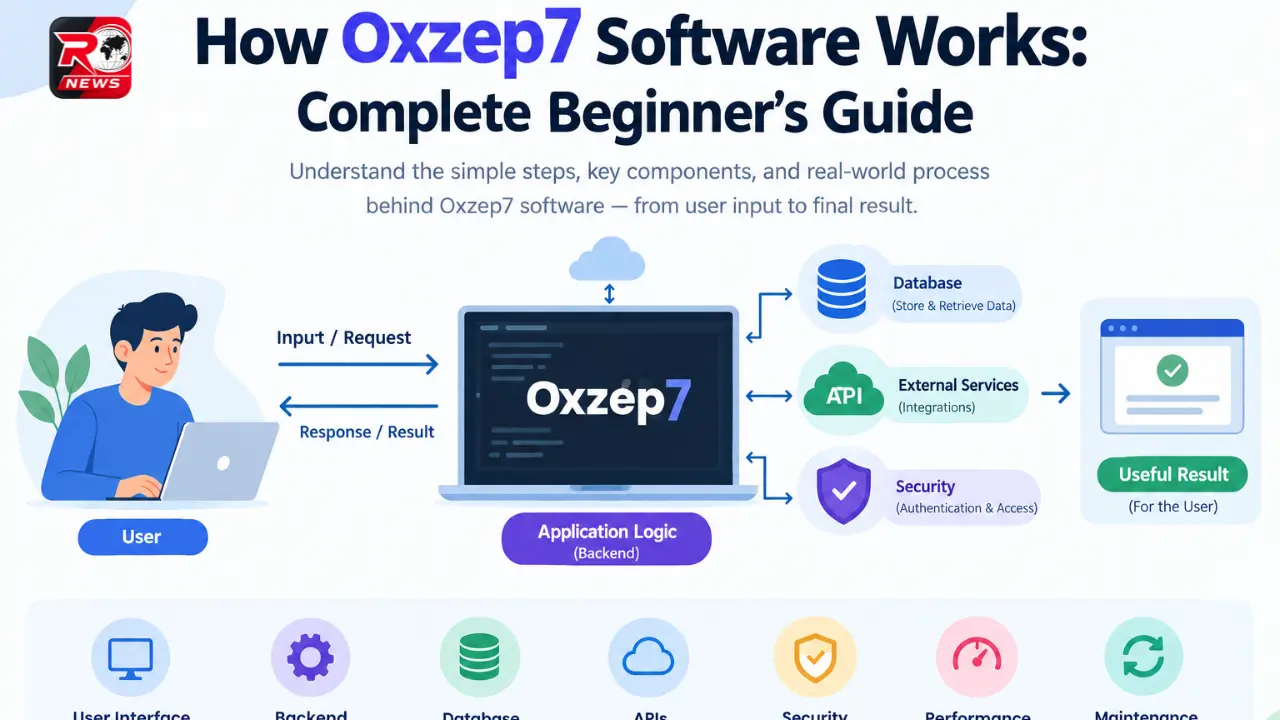
For beginners, the easiest way to understand how oxzep7 software works is to look at software as a connected system rather than a single program. A typical software solution receives information from users or other systems, processes that information through application logic, communicates with databases or external services, and then produces a useful result.
The exact functionality of an Oxzep7 implementation can depend on the particular product, project, or application being discussed. Therefore, it is important not to assume that every system using the Oxzep7 name has identical features. Instead, this guide explains the general principles that help readers understand how oxzep7 software works, including interfaces, processing, databases, APIs, security, performance, testing, and maintenance.
Whether you are a beginner, website owner, technology enthusiast, student, or someone researching software development, this guide provides a straightforward introduction without requiring advanced programming knowledge.
What Is Oxzep7 Software?
Before understanding how oxzep7 software works, it is useful to understand what software means in a broader technical context.
Software is a collection of instructions that tells a computer or digital device how to perform specific tasks. Depending on its purpose, software may help users manage information, communicate, automate processes, analyze data, operate services, or interact with other applications.
The term Oxzep7 may refer to a particular software concept, project, platform, or development-related topic. Because the exact technical specification can vary, users should verify the official documentation or product information associated with the specific Oxzep7 implementation they are using.
From a general software perspective, understanding how oxzep7 software works involves examining several connected layers. The user interacts with an interface, the application processes the request, data may be retrieved or stored, and the system returns an appropriate result.
This basic flow is common across many modern digital applications.
How Oxzep7 Software Works at a Basic Level

At the simplest level, how oxzep7 software works can be explained through an input-process-output model.
A user provides an input. The software receives that information and applies predefined instructions or business logic. If necessary, the application communicates with a database or another service. Finally, the software produces an output that the user can see or use.
For example, imagine a user entering information into a software form. The interface sends that information to the application’s backend. The backend checks whether the information is valid, processes the request, stores or retrieves relevant data, and sends a response back to the interface.
This process can happen in a fraction of a second.
| Software Stage | What Happens | Example |
| User Input | Information enters the system | User submits a form |
| Application Processing | Software evaluates the request | Data is validated |
| Database Interaction | Information is retrieved or stored | Record is saved |
| API Communication | External services may be contacted | Another platform is queried |
| Output | Result is returned | Confirmation appears |
| Monitoring | System activity is recorded | Error or performance log |
This model provides a useful starting point for understanding how oxzep7 software works without needing to understand every programming detail.
Understanding the User Interface
The user interface is the part of software that people interact with directly. It may be a website, desktop application, mobile application, dashboard, form, or another visual environment.
When exploring how oxzep7 software works, the interface is usually the first layer a beginner encounters.
A well-designed interface allows users to enter information, select options, view results, navigate between sections, and perform actions without needing to understand the underlying code.
For example, a user may click a button to request information. The interface itself may not perform the complete operation. Instead, it sends a request to the backend system, waits for the response, and displays the result.
Frontend and Backend
Modern applications commonly have frontend and backend components.
The frontend handles much of what users see and interact with. HTML, CSS, JavaScript, and frontend frameworks are commonly used to create web interfaces.
The backend operates behind the scenes. It handles application logic, authentication, database communication, APIs, and other server-side processes.
Understanding this separation makes how oxzep7 software works much easier to visualize.
The Role of the Backend
The backend can be considered the processing center of a software application.
When a user performs an action, the frontend may send a request to the backend. The backend then determines what should happen.
Suppose a user requests a particular piece of information. The backend may check the user’s permissions, validate the request, query a database, process the returned information, and send the appropriate response.
This is one of the most important concepts when learning how oxzep7 software works.
The backend can also contain business rules. These rules determine how the application behaves under different circumstances.
For example, a system might prevent unauthorized users from accessing restricted information. Another application might calculate prices, generate reports, process forms, or automate a business operation.
How Databases Work With Oxzep7 Software
A database is used to store and organize information. Many modern applications depend heavily on databases because software needs a reliable way to save and retrieve data.
When studying how oxzep7 software works, database interaction is an important concept.
Imagine an application that stores customer information. When a user creates an account, the application may send the relevant information to a database. Later, when the user signs in, the application retrieves the appropriate account information.
Different types of databases exist for different requirements.
| Database Type | General Characteristics | Common Use |
| Relational Database | Structured tables and relationships | Business applications |
| Document Database | Flexible document-style data | Variable data structures |
| Key-Value Database | Simple key and value storage | Caching and fast lookups |
| Cloud Database | Managed infrastructure | Scalable applications |
The choice depends on the application’s requirements rather than the software name itself.
Why Data Organization Matters
Poorly organized data can cause slow performance, duplication, errors, and difficult maintenance.
A properly designed database makes it easier for software to find the information it needs.
Therefore, anyone researching how oxzep7 software works should understand that databases are often an important part of the system even though users may never see them directly.
How APIs Can Connect Oxzep7 Software
API stands for Application Programming Interface. APIs allow different software systems to communicate with each other.
This is particularly important in modern applications because software rarely operates completely alone.
For example, an application might communicate with a payment service, email provider, analytics platform, authentication system, or another external application through an API.
Understanding APIs makes how oxzep7 software works easier to understand because APIs often act as communication channels between different components.
A typical API request includes information about what the application wants to do. The external service processes that request and returns a response.
REST APIs
REST APIs are widely used for web applications. They commonly use HTTP methods such as GET, POST, PUT, PATCH, and DELETE.
GraphQL APIs
GraphQL provides another approach where clients can request specific data structures.
The appropriate approach depends on project requirements, architecture, and development preferences.
How Authentication Works
Authentication is the process of confirming a user’s identity.
When someone logs into an application, the system needs to determine whether the provided credentials are valid.
This can involve usernames, passwords, authentication tokens, multi-factor authentication, or external identity providers.
When explaining how oxzep7 software works, authentication is important because modern applications often contain information that should only be available to authorized users.
Passwords should not be stored as ordinary readable text. Secure password hashing should be used instead.
Authentication should also be separated from authorization.
Authentication answers the question, “Who are you?”
Authorization answers the question, “What are you allowed to access?”
This distinction is fundamental to secure software design.
How Oxzep7 Software Works With Security
Security is not a single feature. It is a collection of practices designed to protect applications, users, data, and infrastructure.
Anyone researching how oxzep7 software works should understand that security can affect nearly every part of the system.
Input validation helps prevent applications from accepting dangerous or invalid information. Access controls prevent unauthorized users from reaching restricted functionality. Secure communication protects information while it travels between systems.
Software dependencies should also be maintained because outdated components can introduce security risks.
Backups are another important security and reliability measure. If important information is lost, a tested backup can help restore the system.
How Data Moves Through the System
One of the easiest ways to understand how oxzep7 software works is to imagine data traveling through different layers.
A user starts by interacting with the interface. The interface creates a request and sends it to the backend. The backend evaluates the request and may communicate with a database or external API.
After processing is complete, the backend sends a response to the frontend. The interface then presents the result to the user.
This process is sometimes extremely fast, which can make the underlying architecture invisible to ordinary users.
A Simple Example
Imagine a user searches for a record inside an application.
The user enters a search term. The interface sends the term to the backend. The backend validates the request and queries the database. The database returns matching information. The backend processes the result and sends it back to the interface.
The user then sees the matching information on the screen.
This simple example demonstrates the fundamental flow behind many software systems.
Performance and Speed

Performance is another important part of understanding how oxzep7 software works.
A system can technically function correctly while still providing a poor user experience if it takes too long to respond.
Performance can be affected by many factors, including server resources, database queries, network conditions, inefficient code, large files, and third-party services.
Developers can use caching, optimized database queries, efficient code, compressed assets, and appropriate infrastructure to improve performance.
However, optimization should be based on actual measurements rather than assumptions.
Why Caching Helps
Caching allows frequently requested information to be temporarily stored so the application does not need to perform the same expensive operation repeatedly.
For applications with repeated requests, caching can significantly reduce processing requirements.
How Software Handles Errors
No software system is completely immune to errors.
A useful application should be designed to handle unexpected situations gracefully.
When learning how oxzep7 software works, error handling is an important concept because the software needs to know what to do when something goes wrong.
A database might become temporarily unavailable. A user might enter invalid information. An external API might fail to respond. A server might run out of resources.
Instead of simply crashing, a well-designed application can detect the problem, record useful information in logs, and present an understandable message to the user.
Good error messages should help users understand what happened without exposing sensitive technical information.
How Developers Test Oxzep7 Software
Testing helps developers determine whether software behaves as expected.
Before software reaches users, developers can test individual functions, components, integrations, complete workflows, performance, and security.
When discussing how oxzep7 software works, testing is important because software behavior should be verified rather than assumed.
| Testing Method | Purpose |
| Unit Testing | Checks individual functions |
| Integration Testing | Checks communication between components |
| End-to-End Testing | Checks complete user workflows |
| Performance Testing | Measures system behavior under load |
| Security Testing | Identifies security weaknesses |
| Regression Testing | Checks whether updates break existing features |
Testing can happen during development and after major changes.
Automated testing can also reduce repetitive manual work and make it easier to detect problems early.
How Oxzep7 Software Can Be Deployed
Deployment means making software available in its intended environment.
A web application might be deployed to cloud infrastructure, a virtual private server, dedicated hardware, or an organization’s internal environment.
When explaining how oxzep7 software works, deployment is important because software needs infrastructure where its code can execute and where users can access it.
Modern deployment can involve automated pipelines. Developers can commit code to a repository, run automated tests, and deploy approved changes to a staging or production environment.
A staging environment is particularly useful because it allows teams to test changes before releasing them to real users.
Monitoring After Deployment
Software development does not end when an application goes live.
Once deployed, developers need to monitor the system to identify errors, performance issues, unusual activity, and infrastructure problems.
Monitoring helps explain how oxzep7 software works in the real world, because actual usage can reveal problems that were not visible during development.
Logs can show application errors. Performance monitoring can reveal slow requests. Infrastructure monitoring can show CPU, memory, storage, and network usage.
Alerts can notify technical teams when important thresholds are exceeded.
Software Updates and Maintenance
Technology changes continuously. Software therefore requires regular maintenance.
Updates may involve bug fixes, security patches, performance improvements, compatibility changes, and new functionality.
Understanding how oxzep7 software works should include an understanding of this ongoing lifecycle.
An application that is never maintained can eventually become difficult to operate because its dependencies become outdated, security risks increase, and compatibility with newer systems may decline.
Maintenance also provides an opportunity to improve the user experience based on feedback.
How Scalability Affects Oxzep7 Software
Scalability describes a system’s ability to handle increasing workloads.
A small application may work perfectly with a limited number of users. However, if usage increases dramatically, the architecture may need additional resources or optimization.
When considering how oxzep7 software works, scalability becomes particularly important for applications expected to grow.
Vertical scaling means increasing the resources of existing infrastructure. Horizontal scaling means adding additional instances or servers.
Caching, load balancing, database optimization, background processing, and efficient architecture can all contribute to scalability.
The best strategy depends on the actual workload and system requirements.
The Difference Between Developing and Using Oxzep7 Software
It is important to distinguish between develop oxzep7 software and how oxzep7 software works.
Developing software focuses on the creation process. It involves requirements, architecture, programming, testing, deployment, and maintenance.
Understanding how software works focuses more on the operational side. It explains how the components communicate and how a user’s action becomes a result.
This distinction is useful for SEO as well as for readers because these two search intents are related but not identical.
Someone searching for development information may want technical instructions. Someone searching for how oxzep7 software works may simply want to understand the system’s functionality and workflow.
Common Beginner Questions About Oxzep7 Software
Beginners often assume that understanding software requires advanced programming knowledge. That is not necessarily true.
The basic architecture can be understood without writing code. Once someone understands the relationship between interface, backend, database, APIs, security, and infrastructure, more advanced technical concepts become easier to learn.
When researching how oxzep7 software works, readers should also distinguish between confirmed information about a specific Oxzep7 product and general software-development principles.
If official technical documentation exists for a particular Oxzep7 implementation, that documentation should take priority over assumptions or unofficial descriptions.
My Opinion: How Oxzep7 Software Works
In my opinion, the easiest way for a beginner to understand how oxzep7 software works is to stop thinking of software as one mysterious program.
Instead, think of it as a group of connected parts that each have a specific job.
The interface communicates with the backend. The backend handles the logic. The database stores information. APIs allow systems to communicate. Security controls determine who can access what. Monitoring helps developers understand what happens after deployment.
Once you understand this basic structure, even complicated software becomes easier to analyze.
I also think beginners should avoid trying to learn every programming technology at once. Understanding the underlying concepts is more valuable initially than memorizing dozens of frameworks.
A simple mental model can take you surprisingly far: input → processing → data → response.
That model explains a large part of how modern applications operate.
Future of Software Like Oxzep7

The future of software development is likely to involve increasing automation, cloud infrastructure, artificial intelligence, real-time processing, stronger security, and more integration between different platforms.
AI-assisted development is already changing how developers write and review code. Automated testing and deployment are also becoming increasingly common.
For software systems associated with the Oxzep7 concept, future capabilities would ultimately depend on the actual product requirements, technical architecture, and development direction.
Understanding how oxzep7 software works today can nevertheless provide a foundation for understanding more advanced software systems tomorrow.
As applications become more connected, API design, data protection, performance, and interoperability will become increasingly important.
Conclusion
Learning how oxzep7 software works becomes much easier when the system is viewed as a collection of connected components rather than a single mysterious application.
The user interface provides the point of interaction. The backend processes requests and applies application logic. Databases store information, while APIs allow different systems to communicate. Authentication and authorization help control access, while testing and monitoring support reliability.
The exact functionality of an Oxzep7 implementation can depend on the particular project or product being discussed, so specific technical claims should always be checked against reliable documentation.
For beginners, however, the fundamental software model remains useful: a user provides input, the system processes it, data may be retrieved or stored, and a response is returned.
Once this foundation is understood, concepts such as APIs, databases, authentication, scalability, deployment, and monitoring become much easier to understand. That is the real value of learning how oxzep7 software works.
Frequently Asked Questions
What is Oxzep7 software?
Oxzep7 software can refer to a particular software project, platform, or development concept. Its exact features depend on the specific implementation. General software principles can help explain how such a system may operate.
How oxzep7 software works in simple terms?
At a basic level, a software system receives user input, processes that information using application logic, communicates with databases or external services when necessary, and returns a result to the user.
Does understanding how oxzep7 software works require programming knowledge?
No. Basic concepts such as frontend, backend, database, API, authentication, and data processing can be understood without advanced programming experience. Programming knowledge becomes useful when you want to build or modify the software.
Is database technology important for Oxzep7 software?
Database technology can be an important part of modern software because applications frequently need to store and retrieve information. The appropriate database depends on the specific requirements of the application.
Can Oxzep7 software be improved over time?
Software can generally be improved through updates, bug fixes, performance optimization, security improvements, new features, and user feedback. The appropriate improvements depend on the particular Oxzep7 implementation and its objectives and more.
