

Table of Contents
Understanding how does EndBugFlow software work starts with understanding a common problem in modern software development: finding a bug is often easier than understanding why it happened. A developer may receive an error message, a customer complaint, or a failed test, but the information available at that moment may not explain the complete sequence that caused the problem.
Endbugflow.com presents Endbugflow as a platform focused on debugging foundations, workflow optimization, technical concepts, root-cause analysis, and end-to-end debugging frameworks. Its stated approach is centered on discovering a problem, analyzing its technical context, refining a solution, and applying an optimized workflow.
So, how does EndBugFlow software work in practical terms? The concept can be understood as a structured process that connects problem detection, technical investigation, issue organization, collaboration, resolution, and continued monitoring. However, an important point is that publicly available documentation about a specific commercial EndBugFlow application is limited, and several detailed capabilities described by third-party websites are not independently confirmed by official technical documentation.
This guide explains the concept in simple language while separating documented information from reported or claimed functionality.
What Is EndBugFlow Software?
Before exploring how does EndBugFlow software work, it is useful to clarify what the Endbugflow name represents online.
The official Endbugflow website describes itself primarily as a technical knowledge and development-focused platform. Its content covers debugging strategies, workflow optimization, core technology concepts, and practical approaches to solving software-development problems. The site describes its process through stages such as discovering the problem, analyzing and refining the situation, and optimizing and applying an appropriate solution.
This is slightly different from describing a conventional bug-tracking application.
A traditional bug tracker normally focuses on recording a problem, assigning responsibility, monitoring status, and documenting resolution. A debugging workflow goes deeper because it attempts to understand the technical reason behind the failure.
That distinction is important when discussing how does EndBugFlow software work. Public third-party articles sometimes describe EndBugFlow as a complete software application capable of automated error capture, issue management, monitoring, collaboration, and integrations. Those descriptions may represent intended functionality or interpretations of the platform, but they should not automatically be treated as independently verified technical specifications.
The Main Idea Behind EndBugFlow

At a conceptual level, EndBugFlow can be understood as an end-to-end approach to handling software problems.
The basic journey looks like this:
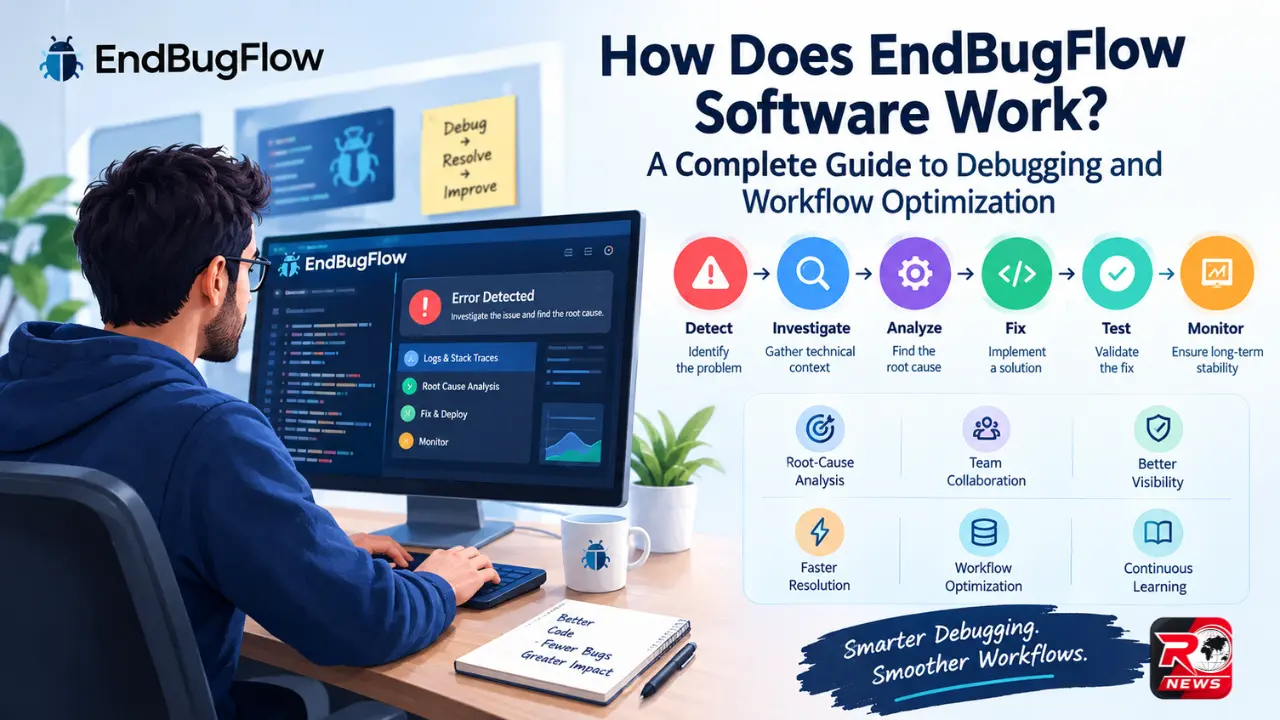
Problem detected → technical information gathered → issue understood → solution developed → fix tested → system monitored
This approach reduces the separation between debugging and development workflow.
Instead of treating an error as an isolated event, the goal is to understand what happened, why it happened, what was affected, and how the development process can prevent the same type of problem from happening again.
How Does EndBugFlow Software Work?
The simplest answer to how does EndBugFlow software work is that it is associated with a structured debugging workflow designed to move a technical problem from discovery toward analysis and resolution.
The official platform emphasizes understanding system behavior and technical constraints before attempting to optimize a solution.
A modern debugging workflow generally starts when an application behaves differently from what developers expect. That could be a crash, failed request, incorrect calculation, broken interface, database error, slow response, or unexpected application behavior.
Once the problem is recognized, developers need context.
For example, knowing that a website returned an error is not enough. Developers may need to know which function was running, what input was supplied, which API request occurred, what environment was being used, and what happened immediately before the failure.
This is why the central idea behind how does EndBugFlow software work is not simply “find bugs.” The larger objective is to create a process where technical problems can be investigated systematically rather than through guesswork.
From Error Detection to Investigation
A useful debugging system turns a vague complaint into structured technical information.
Imagine that a user reports that a checkout page stopped working. A basic report might simply say:
“Checkout does not work.”
A more useful debugging workflow would attempt to establish the application version, browser or device environment, relevant error message, request status, affected component, and sequence of events surrounding the failure.
That additional context makes investigation much easier.
This is one reason how does EndBugFlow software work is closely connected with root-cause analysis. A good debugging process does not stop after identifying the visible symptom. It attempts to determine the underlying reason.
How Does EndBugFlow Software Work in a Development Workflow?
The practical value of a debugging workflow becomes clearer when it is placed inside the software development lifecycle.
A software team may have developers, testers, project managers, DevOps specialists, and product owners working on the same application. If a problem is discovered, communication between these people becomes important.
Without a structured workflow, information can become scattered across email, chat messages, screenshots, source-code comments, spreadsheets, and separate issue systems.
The idea behind how does EndBugFlow software work is to make the debugging process more structured and connected.
| Development Stage | Purpose | Typical Information |
| Detection | Identify abnormal behavior | Error, crash, failed test |
| Investigation | Understand the problem | Logs, stack traces, environment |
| Analysis | Search for the cause | Code path, dependencies, requests |
| Resolution | Implement a fix | Code changes, configuration changes |
| Verification | Confirm the fix | Testing and validation |
| Monitoring | Watch for recurrence | Application behavior and errors |
This type of lifecycle is consistent with the end-to-end debugging philosophy described by Endbugflow.
Why Context Matters
The biggest advantage of structured debugging is context.
Suppose a developer receives an error saying that a database request failed. That message alone may have several possible explanations. The database could be unavailable, credentials could be incorrect, a query could be malformed, a timeout could have occurred, or an application update could have changed the expected data structure.
Context helps narrow the possibilities.
That is why how does EndBugFlow software work should not be viewed simply as a question about a dashboard or bug list. The more important question is how the workflow helps developers move from symptoms toward evidence-based investigation.
End-to-End Debugging and Root-Cause Analysis
Root-cause analysis is an important concept in understanding how does EndBugFlow software work.
When an application fails, the visible error is not necessarily the original cause.
For example, a website may show a blank page because an API request failed. The API request may have failed because a service returned unexpected data. That service may have received incorrect input from another component. The original problem may therefore be several layers away from what the user actually sees.
A strong debugging methodology follows the chain backward.
The process can involve examining application logs, stack traces, requests, dependencies, configuration, database behavior, recent code changes, and environmental differences.
Endbugflow’s official material emphasizes structured problem solving and root-cause analysis as part of its debugging philosophy.
Stack Traces and Debug Information
Stack traces are particularly valuable because they show the sequence of function calls that led toward an error.
For an experienced developer, a stack trace can reveal where an exception originated and which parts of the application were involved.
This means that a debugging workflow becomes more useful when it preserves technical evidence instead of reducing everything to a simple “bug found” label.
Third-party descriptions of EndBugFlow have claimed capabilities involving contextual error information, logs, network activity, and related technical details. However, because these capabilities are not comprehensively documented in official technical documentation, they should be regarded as reported functionality rather than guaranteed features.
How Does EndBugFlow Software Work With Bug Prioritization?
Another important part of how does EndBugFlow software work is understanding which problems deserve attention first.
Not every bug has the same impact.
A spelling mistake on an internal page is different from a payment failure affecting customers. Similarly, a rare cosmetic problem is different from a security issue or an application crash.
A structured issue-management process therefore needs some method of evaluating impact.
| Example Problem | Potential Impact | Typical Development Concern |
| Minor visual issue | Low | User experience |
| Broken internal feature | Moderate | Productivity |
| Frequent application error | High | Reliability |
| Checkout failure | Very high | Business operations |
| Security vulnerability | Potentially critical | Security and risk |
Some third-party descriptions associate EndBugFlow with prioritization based on factors such as affected users, code areas, feature importance, and overall impact. These descriptions should be treated cautiously because the exact prioritization algorithm is not clearly documented in the official material currently available.
The broader principle, however, is straightforward: development teams need visibility into which problems have the greatest practical consequences.
How Does EndBugFlow Software Work for Team Collaboration?

Software development is rarely a one-person activity.
A developer may discover the issue, a tester may reproduce it, another developer may create the fix, and a project manager may need to track the status.
This is where collaboration becomes important.
When discussing how does EndBugFlow software work, the collaboration concept can be understood as keeping technical information connected to the issue being investigated.
Instead of writing a message such as “the login problem is fixed,” a useful workflow would preserve the relevant information about what caused the issue, what changed, how it was tested, and whether the problem appeared again.
This creates a stronger historical record.
It can also help developers who encounter a similar issue later because they can learn from previous investigations instead of starting from zero.
Why Shared Context Saves Time
Imagine that a developer leaves a project and another developer takes over the application six months later.
If previous debugging work is documented clearly, the new developer can understand the reasoning behind earlier fixes.
If the information exists only in private conversations, much of that knowledge may disappear.
This is one of the most useful principles behind the broader EndBugFlow philosophy: technical clarity should become part of the workflow rather than remaining inside an individual developer’s memory.
How Does EndBugFlow Software Work With Monitoring?
Monitoring is another concept frequently associated with how does EndBugFlow software work.
Debugging traditionally happens after a problem has already been identified. Monitoring takes a more continuous approach by watching application behavior and identifying unusual conditions.
For example, a development team might monitor response times, failed requests, application errors, resource usage, or changes in system behavior.
If a newly deployed version suddenly produces a large increase in errors, monitoring can provide an early warning.
Some third-party descriptions attribute application monitoring and automated detection capabilities to EndBugFlow. However, the official website does not provide a sufficiently detailed public technical specification to independently verify the full scope of those capabilities.
The concept itself is valuable because debugging and monitoring work well together.
Monitoring helps identify unusual behavior.
Debugging helps explain it.
How Does EndBugFlow Software Work After a Bug Is Fixed?
Fixing code does not necessarily mean the problem is permanently solved.
A developer may make a change that resolves the original issue but accidentally introduces another problem.
That is why how does EndBugFlow software work should also be considered from a post-fix perspective.
After a solution is implemented, developers normally test the change. Depending on the application, testing could include unit tests, integration tests, staging tests, regression testing, or real-world monitoring.
The goal is to establish that the original behavior has been corrected without creating unacceptable side effects.
A useful workflow therefore looks more like a cycle than a straight line:
Detect → Investigate → Fix → Test → Monitor → Learn
If the problem returns, the development team can reopen the investigation.
This feedback loop is one of the most important concepts in software quality because applications constantly change.
What Are the Potential Benefits of EndBugFlow?
When considering how does EndBugFlow software work, it is helpful to focus on the potential benefits of a structured debugging approach rather than assuming every advertised feature is available.
The first potential benefit is improved visibility. Developers can work with clearer information about what happened instead of relying only on vague user reports.
The second benefit is better organization. A structured workflow can help teams understand which issues are new, which are being investigated, and which have already been resolved.
Another potential advantage is faster communication. When technical context stays connected to an issue, developers and testers spend less time repeatedly explaining the same problem.
There can also be a long-term learning benefit. Previous debugging investigations can become useful references for future problems.
| Potential Benefit | Why It Matters |
| Better visibility | Developers get clearer information about problems |
| Structured investigation | Problems can be analyzed systematically |
| Team collaboration | Technical context can be shared |
| Faster troubleshooting | Less time may be spent gathering basic information |
| Historical knowledge | Previous fixes can help with future issues |
| Workflow optimization | Repeated development friction can be identified |
These benefits describe the value of structured debugging generally and should not be interpreted as independent verification of every specific EndBugFlow feature.
How Does EndBugFlow Software Work for Different Types of Developers?
Different developers may use debugging workflows in different ways.
A frontend developer might be concerned with browser behavior, interface errors, JavaScript exceptions, API responses, and user interactions.
A backend developer may focus on server errors, databases, APIs, authentication, queues, and application logic.
A DevOps engineer may be more concerned with deployments, infrastructure, availability, logs, and system performance.
The basic idea behind how does EndBugFlow software work can therefore apply across different parts of the development environment, provided the relevant technical information is available.
For beginners, the biggest value may be learning how to investigate problems systematically.
For experienced developers, the value may be reducing repetitive investigation work and improving team-level visibility.
How Does EndBugFlow Software Work Compared With Traditional Bug Tracking?
Traditional bug tracking and debugging are related but not identical.
A bug tracker might answer:
“Which problems are currently open?”
A debugging workflow tries to answer:
“Why did this problem happen?”
That difference is important.
| Traditional Bug Tracking | End-to-End Debugging Approach |
| Records reported issues | Investigates technical causes |
| Tracks status | Connects investigation with resolution |
| Assigns ownership | Preserves technical context |
| Records comments | Encourages structured analysis |
| Focuses on issue lifecycle | Focuses on issue plus technical reasoning |
This comparison does not mean that traditional issue trackers are ineffective. In fact, they remain important in software teams.
The key point is that how does EndBugFlow software work is more closely connected to the broader debugging and workflow concept than simply maintaining a list of tickets.
Is EndBugFlow Software Fully Documented?
This is an important question for anyone researching how does EndBugFlow software work before installing or adopting anything.
The public Endbugflow website provides substantial information about debugging concepts and workflow philosophy. However, publicly available material does not appear to provide the level of technical documentation normally expected from a mature commercial developer platform, such as a comprehensive API reference, clearly documented architecture, detailed release history, or complete product documentation.
Several third-party websites describe additional capabilities, including automated error capture, integrations, monitoring, and issue prioritization. Because those claims are not all supported by detailed first-party technical documentation, readers should verify them directly before depending on them in production.
This distinction is particularly important for developers working with private source code, customer information, credentials, logs, or production systems.
Security and Privacy Considerations
Anyone researching how does EndBugFlow software work should consider security before connecting development infrastructure.
Debugging information can contain sensitive data.
Logs may accidentally include email addresses, authentication information, customer identifiers, URLs, internal system details, or other confidential information.
Before connecting a debugging platform to a production application or source repository, developers should understand what information is collected, where it is stored, how long it is retained, who can access it, and whether sensitive values can be filtered or redacted.
The absence of detailed public documentation should encourage careful verification rather than assumptions.
For professional environments, it is also sensible to review privacy policies, security documentation, access controls, encryption practices, data-retention rules, account permissions, and integration scopes before granting access to sensitive systems.
My Opinion on How Does EndBugFlow Software Work

In my opinion, the most interesting part of how does EndBugFlow software work is not the name of the tool itself but the underlying idea of connecting debugging with the complete software-development workflow.
Many development problems become difficult because information is fragmented. One person has the error message, another has the screenshot, another has the deployment information, and the developer has to reproduce the problem manually.
A system that can genuinely bring useful technical context together can make debugging much more efficient.
At the same time, I would not treat every feature mentioned on third-party websites as confirmed until there is clear official documentation. The public information surrounding Endbugflow is currently more detailed about debugging philosophy and workflow concepts than it is about a fully documented commercial software architecture.
For me, that distinction is important. Good software research should separate what a platform officially documents from what other websites claim.
If you are considering EndBugFlow for an actual development project, I would first verify the official product documentation, installation source, supported environments, security information, pricing, integrations, and current software release before connecting it to important production systems.
How Does EndBugFlow Software Work in a Simple Example?
Consider a web application where users suddenly report that the checkout page is failing.
A structured EndBugFlow-style workflow would begin by recognizing the abnormal behavior.
The next stage would be understanding the context. Developers would want to know what changed, which users are affected, what requests failed, what error was generated, and whether the problem occurs consistently.
The development team could then investigate the relevant code and infrastructure.
Once the root cause is identified, a fix can be developed and tested.
After deployment, the application should continue to be observed to confirm that the error has disappeared and that the fix has not created another issue.
This example demonstrates the central idea behind how does EndBugFlow software work: the important part is the complete journey from problem discovery to verified resolution rather than simply recording that a bug exists.
Frequently Asked Questions About How Does EndBugFlow Software Work
What is EndBugFlow software?
Endbugflow is publicly associated with debugging, workflow optimization, technical concepts, root-cause analysis, and end-to-end development problem solving. Its official website presents it primarily as a technical knowledge platform, while some third-party sources describe a more complete debugging and issue-management application.
How does EndBugFlow software work?
The basic concept is a workflow that moves from detecting a software problem to gathering technical context, analyzing the cause, developing a solution, testing the fix, and continuing to monitor the application. The exact implementation of a dedicated EndBugFlow application is not fully documented publicly.
Is EndBugFlow a bug-tracking tool?
The Endbugflow name is associated with debugging and software workflow management. Some third-party websites describe it as a bug-tracking or issue-management system, but the official public material focuses more broadly on debugging and development knowledge. Therefore, specific bug-tracking features should be verified before relying on them.
Can EndBugFlow automatically find software bugs?
Some third-party sources claim automated error detection and contextual capture, but these capabilities are not comprehensively verified through official technical documentation. It is safer to treat automatic detection as a reported capability until supported by current first-party documentation.
Should developers use EndBugFlow for production software?
Before using any relatively unfamiliar debugging platform with production software, developers should verify its official documentation, security practices, data handling, installation source, integrations, pricing, and support. This is particularly important when logs or source code may contain sensitive information.
Final Thoughts on How Does EndBugFlow Software Work
So, how does EndBugFlow software work? The clearest way to understand it is as an end-to-end debugging and workflow concept that aims to turn software problems into structured investigations and actionable solutions.
The official Endbugflow platform emphasizes discovering problems, analyzing and refining them, and applying optimized workflows. Third-party descriptions add capabilities such as contextual error collection, issue organization, collaboration, prioritization, and monitoring, although the full technical implementation of those capabilities is not independently established through comprehensive public documentation.
The most valuable principle is therefore straightforward: effective debugging should not stop at identifying an error. Developers need context, evidence, communication, testing, and follow-up monitoring.
For anyone researching how does EndBugFlow software work, that distinction between the documented philosophy and unverified product claims is worth remembering. It provides a more accurate understanding of what Endbugflow represents while avoiding assumptions about technical features that have not been clearly documentedn and more.
