

Table of Contents
Introduction
Finding reliable information about foxtpax software can be surprisingly difficult because the name appears across different online discussions, articles, and technology-focused pages that do not always describe the platform in exactly the same way. Some public material presents Foxtpax as a technology intelligence and optimization platform, while other pages associate it with secure storage, encryption, decentralized data protection, network architecture, smart devices, and software development. This makes it important to separate clearly reported information from claims that still require verification.
The most useful information about foxtpax software currently available suggests that the platform is positioned around modern technology management, intelligent information processing, optimization, and data protection. Its online presence also discusses areas such as innovation alerts, network architecture insights, smart-device developments, technology optimization, and developer-oriented resources.
For anyone researching unfamiliar software, the goal should not simply be to repeat marketing language. Good software research means understanding what a platform is designed to do, who may benefit from it, what its technical claims mean, and what should be verified before using it for important business or personal information.
This detailed guide provides practical information about foxtpax software, explains the different descriptions found online, examines its possible applications, discusses security considerations, and gives a realistic perspective on whether it may be useful for modern technology users.
What Is Foxtpax Software?
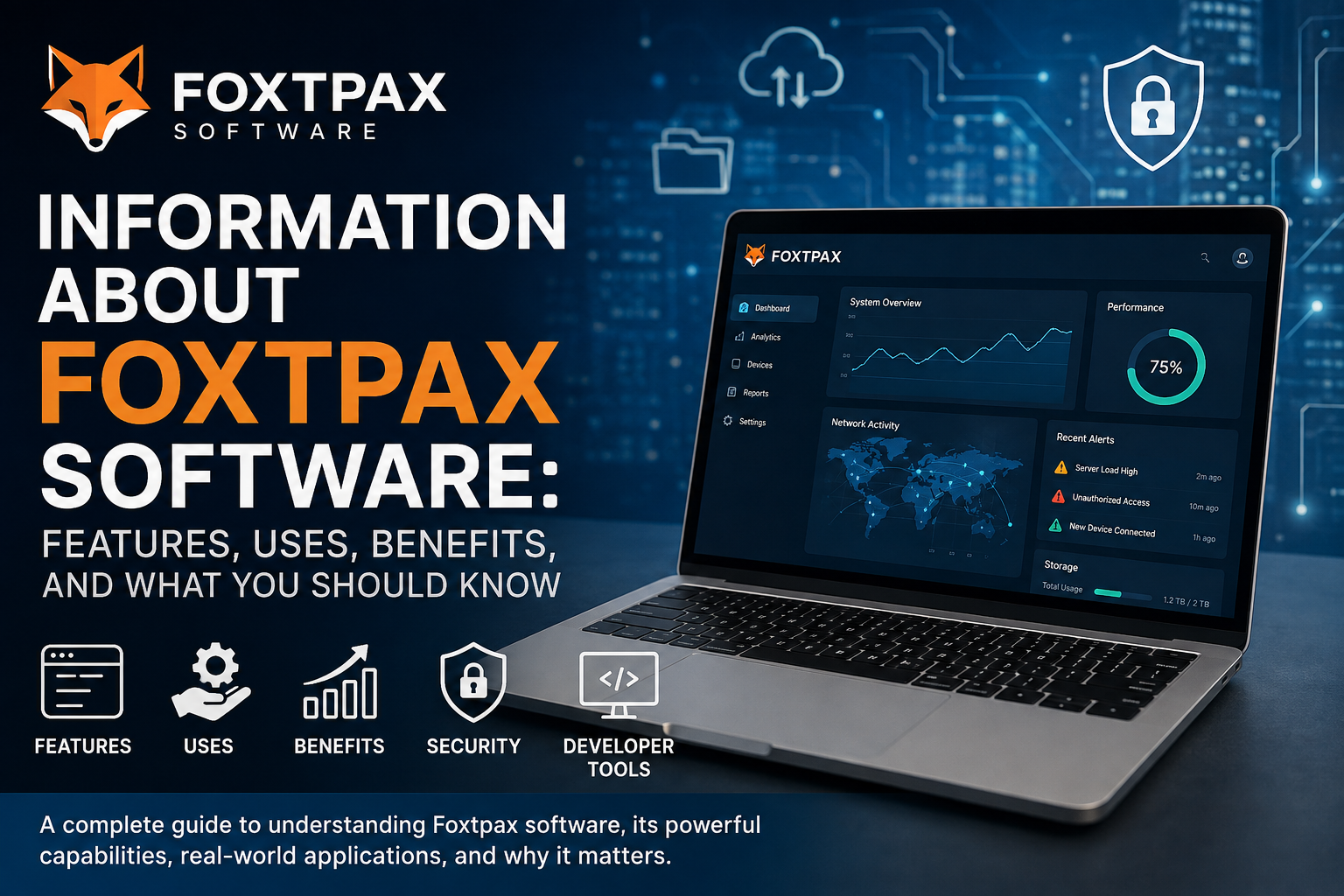
The simplest way to understand information about foxtpax software is to view Foxtpax as a technology-focused software concept rather than assuming it is a conventional application with one narrowly defined purpose. Public Foxtpax material describes a platform concerned with turning complicated technology developments into more understandable and potentially actionable information.
The official Foxtpax website describes technology intelligence involving innovation alerts, smart-device advancements, network architecture insights, technology concepts, and optimization ideas. This positioning makes Foxtpax particularly interesting to developers, technology professionals, IT architects, product teams, and people who need to monitor changes in digital infrastructure.
At the same time, another Foxtpax page describes a security-oriented architecture involving client-side encryption and decentralized storage. In that description, files can be encrypted before transmission and divided into protected fragments across distributed nodes.
Because these descriptions cover different aspects of technology, users should avoid assuming that every feature mentioned online belongs to one confirmed commercial package. The available public documentation is limited, and some third-party articles make broader claims than the official material.
That distinction is an important part of trustworthy information about foxtpax software. A responsible reader should treat confirmed vendor information separately from third-party descriptions and should verify specific features before making a purchasing or deployment decision.
Understanding the Different Foxtpax Descriptions
One reason searches for information about foxtpax software can produce confusing results is that different websites describe Foxtpax in different ways. Some pages focus on technology intelligence, while others discuss secure storage, Python-related development, network monitoring, or broader business functionality.
The official website currently contains content describing Foxtpax as a source of technology intelligence and network architecture insights. It also publishes material discussing software optimization and Python-related development. One page describes Foxtpax as an SDK or library intended for programmatic interaction with technology systems, monitoring, management, and optimization.
Other third-party publications have described Foxtpax as a broader business-management platform incorporating areas such as CRM, workflow automation, financial tools, reporting, collaboration, and integrations. However, those claims are not consistently supported by clear public vendor documentation.
This difference matters. When researching information about foxtpax software, it is better to say that these capabilities have been reported online rather than presenting every claim as an independently verified fact.
The following table summarizes the major descriptions currently associated with Foxtpax.
| Area | How Foxtpax Is Described Publicly | Verification Consideration |
| Technology intelligence | Curated technology developments and innovation information | Appears on official Foxtpax pages |
| Network architecture | Insights related to networks and infrastructure | Discussed on official pages |
| Smart devices | Technology developments and device-related information | Reported on official website |
| Optimization | Technology optimization and performance ideas | Reported publicly |
| Data security | Encryption and decentralized storage concepts | Described on official Foxtpax content |
| Python development | Developer-focused monitoring and management concepts | Discussed on official pages |
| Business management | CRM, finance, workflow, reporting, and collaboration | Mainly reported by third-party sources |
| FX functionality | Foreign-exchange-related use cases | Requires direct verification |
Core Features Associated With Foxtpax
A major part of information about foxtpax software concerns its technology intelligence capabilities. The platform’s public content emphasizes the problem of information overload. Modern developers and IT professionals can encounter thousands of technology updates, product announcements, research developments, and infrastructure changes, making it difficult to identify information that actually matters.
Foxtpax presents itself as a way to filter that noise and focus attention on technology signals that may have practical importance. Its published material discusses innovation alerts, network architecture developments, smart-device advancements, and technology optimization.
This concept is particularly relevant to organizations that cannot afford to monitor every technology source manually. A well-designed intelligence system can potentially reduce research time by organizing information according to technical relevance.
Another aspect of information about foxtpax software involves data processing. Public descriptions mention crawlers, data feeds, normalization, tagging, and analysis as parts of an intelligence workflow. The stated objective is to move from raw information toward more meaningful insights rather than simply displaying headlines.
Whether the implementation performs exactly as described should still be evaluated through direct testing. A platform can have a compelling concept while producing different results depending on data quality, configuration, integration, and user requirements.
Foxtpax and Technology Intelligence
Technology intelligence is becoming increasingly important because software ecosystems change rapidly. A development team might need to monitor programming languages, cloud infrastructure, cybersecurity developments, networking standards, AI tools, hardware releases, and emerging frameworks simultaneously.
The available information about foxtpax software suggests that its technology intelligence approach is intended to reduce this burden by organizing developments into useful categories. Instead of expecting users to search dozens of websites every day, the platform is presented as a system for collecting and interpreting relevant technology signals.
The official website describes its focus on information that can help developers, IT architects, product managers, and technology leaders make more informed decisions.
For example, a network architect may care more about changes in network infrastructure than consumer gadget announcements. Similarly, a software developer may need information about programming tools and APIs rather than general technology news.
This kind of contextual filtering is where software intelligence platforms can potentially create value. However, the quality of the result depends heavily on the quality of the underlying sources and the accuracy of the filtering process.
Foxtpax and Data Security
Security is another important area when researching information about foxtpax software. The official Foxtpax security-focused material describes a system based on client-side encryption and decentralized storage. According to that description, information is encrypted before it leaves the user’s device and can be divided into encrypted shards distributed across multiple nodes.
The basic idea is straightforward. Traditional centralized storage can create a concentrated target because large amounts of information may exist within one infrastructure environment. A distributed architecture attempts to reduce dependence on one storage location.
The security model described by Foxtpax involves multiple stages.
| Security Concept | General Purpose |
| Client-side encryption | Protects information before transmission |
| Encryption keys | Prevent unauthorized interpretation of protected data |
| Data sharding | Divides information into smaller pieces |
| Distributed storage | Reduces dependence on a single storage location |
| Node distribution | Spreads protected data across infrastructure |
| Data sovereignty | Emphasizes greater user control over information |
It is important, however, to distinguish an architectural description from a security audit. Information about foxtpax software should not be interpreted as proof that any security system is completely immune to breaches. Real security depends on encryption implementation, key management, authentication, infrastructure controls, software updates, access policies, and independent testing.
Before storing sensitive business information, users should request current security documentation and understand exactly how keys, backups, recovery, access permissions, and account restoration work.
How Foxtpax Could Help Developers
Developers may find information about foxtpax software particularly relevant because the platform’s public material discusses Python, monitoring, automation, network management, and technology optimization.
One Foxtpax page describes a Python-oriented approach intended to provide programmatic tools for monitoring and managing technology environments. Rather than treating the software as a simple desktop application, the page describes it as something developers could interact with through code.
That concept could be useful in environments where developers need to monitor multiple systems without constantly switching between separate dashboards.
For example, a development team might want technology monitoring to become part of an automated workflow. A system could potentially identify an event, analyze its importance, and trigger an action through an integration. The exact capabilities, APIs, authentication methods, and supported programming environments should be verified through current official documentation before implementation.
The developer angle also makes information about foxtpax software relevant to organizations building internal tools. Technology platforms become more valuable when they can connect with existing systems instead of forcing teams to replace everything they already use.
Foxtpax for Network Architecture and Infrastructure
Network infrastructure is another area frequently associated with information about foxtpax software. Modern organizations depend on increasingly complicated networks containing cloud systems, local infrastructure, connected devices, remote users, APIs, and security controls.
Understanding what happens across such an environment can be difficult without appropriate monitoring and analytical tools. Foxtpax’s public content emphasizes network architecture insights and optimization, suggesting that one of its objectives is to help users understand technical environments rather than simply collect information about them.
For infrastructure teams, the potential value is not merely receiving more alerts. Too many alerts can create another form of information overload. The more useful approach is to identify important events, understand their context, and prioritize them according to potential impact.
That principle should be considered when evaluating Foxtpax. A prospective user should ask whether the platform provides measurable improvements in monitoring efficiency, incident detection, system visibility, or infrastructure performance.
Foxtpax and Smart Device Management
The growing number of connected devices has made smart-device management increasingly complicated. Homes and organizations may contain cameras, sensors, appliances, computers, phones, routers, industrial equipment, and other connected hardware.
Public information about foxtpax software includes references to smart-device advancements and device integration. The Foxtpax website discusses the challenge of making different devices communicate effectively and presents its technology approach as a way of improving connectivity and management.
The practical benefit of this type of platform depends on compatibility. A solution may sound powerful, but its usefulness is limited if it cannot communicate with the devices and protocols a user actually operates.
Anyone considering Foxtpax for connected-device management should therefore verify supported hardware, communication standards, APIs, operating systems, authentication methods, and automation options before deployment.
Potential Benefits of Foxtpax Software
The available information about foxtpax software suggests several potential benefits, particularly for users who deal with complex technology environments.
The first potential benefit is reduced information overload. Instead of manually checking large numbers of technology sources, users may be able to focus on curated information relevant to their interests.
The second potential benefit is improved visibility. When technology data is organized into meaningful categories, teams can potentially identify changes more quickly and make decisions with better context.
The third potential benefit is automation. If the platform supports programmatic workflows and integrations as described in its developer-focused material, repetitive monitoring and management tasks may become easier to automate.
The fourth potential benefit is security-oriented data management. The decentralized and encrypted architecture described by the official website could be attractive to users who place a high value on privacy and data control.
The following table provides a practical overview.
| Potential Benefit | Why It Matters |
| Information filtering | Reduces time spent searching for relevant technology developments |
| Technology monitoring | Helps teams stay aware of infrastructure changes |
| Automation | Can reduce repetitive manual tasks |
| Developer integration | May support technology workflows through programming |
| Security focus | Provides an architecture emphasizing encryption and data control |
| Infrastructure insight | Can help organize network-related information |
| Device awareness | May assist with connected technology environments |
These should be considered potential benefits rather than guaranteed outcomes. Actual results depend on implementation, supported features, data sources, and the user’s specific environment.
Possible Limitations and Concerns
A balanced discussion of information about foxtpax software must also address uncertainty. The biggest issue is not necessarily a technical weakness; it is the limited amount of independently verified public information.
Several third-party websites describe Foxtpax in ways that differ substantially from the official website. Some describe a comprehensive business-management suite, while the official site emphasizes technology intelligence and secure decentralized storage.
This inconsistency means users should avoid making major decisions based solely on search-engine articles.
Another concern is the absence of extensive independent reviews. Established enterprise software usually has a large ecosystem of customer feedback, technical documentation, security information, integration guides, pricing details, and independent evaluations.
When those resources are limited, due diligence becomes more important.
The following table highlights questions worth answering before adoption.
| Evaluation Area | What a Buyer Should Verify |
| Product identity | What exact Foxtpax product or edition is being offered? |
| Features | Which capabilities are officially supported today? |
| Pricing | What are the current subscription or licensing costs? |
| Security | Is there independent security testing or audit documentation? |
| Integrations | Which platforms and APIs are officially supported? |
| Support | What technical support channels are available? |
| Data ownership | Who owns uploaded or generated information? |
| Data location | Where is customer information stored? |
| Export | Can users easily export their information? |
| Reliability | Are uptime and service commitments documented? |
Is Foxtpax Software Safe to Use?
The question of safety is one of the most important parts of information about foxtpax software. A software product should not be considered safe simply because its website mentions encryption or privacy.
Security must be evaluated across the entire system. This includes account security, password policies, multifactor authentication, encryption, software updates, server protection, employee access, backups, recovery procedures, logging, and vulnerability management.
Foxtpax’s official security material makes strong claims about encryption and decentralized storage. Those claims are interesting, but users handling sensitive information should still request technical documentation and independent evidence where available.
My opinion is that Foxtpax should currently be approached with curiosity plus verification. The concepts discussed publicly are technically interesting, particularly the combination of technology intelligence, optimization, and security-focused architecture. However, I would not recommend putting highly sensitive business information into any relatively unfamiliar platform until its security practices, ownership, documentation, support, and recovery processes have been independently evaluated.
That is not a criticism of Foxtpax specifically. It is simply good software-buying practice.
Who May Benefit From Foxtpax?
The strongest potential audience for information about foxtpax software appears to be technology-oriented users who need better visibility into changing digital environments.
Developers may be interested in programming-related resources, automation, and technology monitoring. IT professionals may find network architecture and optimization concepts relevant to infrastructure management. Technology leaders may appreciate curated information that helps them understand emerging developments.
Businesses interested in privacy-focused storage may also investigate the security architecture described by Foxtpax. However, organizations should confirm that the available product actually meets their compliance and operational requirements before adopting it.
Individual technology enthusiasts may find the platform useful as a source of information about emerging devices, networking concepts, and optimization techniques.
The key point is that the right audience depends on which part of the Foxtpax offering is actually being considered. A person looking for a secure storage platform has different requirements from a developer looking for an SDK or a technology manager seeking intelligence.
How to Evaluate Foxtpax Before Using It
Good information about foxtpax software should lead to better decisions, not simply encourage adoption. Before creating an account or purchasing a service, users should first identify the exact problem they want Foxtpax to solve.
If the objective is technology intelligence, evaluate the quality, relevance, freshness, and accuracy of its information. If the objective is security, examine encryption, key management, storage architecture, access controls, and recovery. If the objective is software development, investigate API documentation, SDK availability, authentication, rate limits, supported languages, and technical support.
A small test is usually better than a large commitment. Where possible, users should begin with non-sensitive data and evaluate performance before moving important workloads.
Another valuable test is data portability. If the service becomes unavailable or no longer meets expectations, users should know how to retrieve their information in a usable format.
Foxtpax Compared With Traditional Software Tools
The value of information about foxtpax software becomes easier to understand when it is compared with traditional tools.
Traditional technology environments often involve separate applications for monitoring, storage, communication, analytics, device management, and development. Each tool may solve one problem very well but create additional complexity through integrations and duplicated data.
Foxtpax’s public positioning appears to move toward greater integration between technology information, optimization, and infrastructure management. However, the exact scope depends on the specific product features currently available.
| Factor | Traditional Separate Tools | Foxtpax Concept |
| Information sources | Often fragmented | Designed around centralized intelligence |
| Monitoring | May require several dashboards | Presented as a unified approach |
| Optimization | Often manual or tool-specific | Emphasized as part of the platform |
| Security | Depends on each service | Public material emphasizes encryption |
| Development | Separate scripts may be needed | Developer integration is discussed |
| Infrastructure | Multiple monitoring systems | Network insights are emphasized |
This comparison should be treated as conceptual rather than a formal benchmark. Independent performance testing would be needed to establish measurable superiority.
The Future Potential of Foxtpax

The broader information about foxtpax software points toward an interesting direction in technology: combining intelligence, automation, optimization, and security into connected workflows.
As organizations generate more data, the challenge is increasingly about interpretation rather than collection. Businesses already have enormous amounts of operational information. The real challenge is identifying which information matters and determining what action should follow.
Technology platforms that can intelligently filter information, connect systems, automate repetitive processes, and protect sensitive data could become increasingly valuable.
Foxtpax’s published material reflects this general direction. Its technology intelligence pages focus on reducing noise, while its security content emphasizes protecting information through encryption and distributed architecture.
The opportunity is significant, but the product must ultimately prove its value through reliable performance, transparent documentation, security evidence, useful integrations, and customer support.
Final Thoughts on Information About Foxtpax Software
The best information about foxtpax software currently available presents an intriguing but somewhat complex picture. Foxtpax has a public technology-focused presence covering innovation intelligence, network architecture, smart-device developments, optimization, software development, and security concepts. Its official material also describes encryption and decentralized storage as important parts of its security-oriented approach.
At the same time, online descriptions are not completely consistent. Some third-party sources describe broader business-management capabilities, including CRM, financial workflows, reporting, and other enterprise functions, but those claims should be verified directly rather than accepted automatically.
My overall opinion is that Foxtpax is worth researching if you are interested in technology intelligence, optimization, network architecture, or privacy-oriented software concepts. However, I would treat it as a platform that deserves careful due diligence rather than assuming every feature mentioned online is confirmed.
In short, information about foxtpax software is useful for understanding the ideas and capabilities associated with the platform, but prospective users should rely on current official documentation, direct demonstrations, security evidence, pricing information, and clear product specifications before making an important technical or financial commitment.
Frequently Asked Questions About Foxtpax Software
What is Foxtpax software?
Foxtpax is presented online as a technology-focused software platform associated with technology intelligence, innovation alerts, network architecture, optimization, smart devices, and security-oriented data management. Its official online material also discusses encryption and decentralized storage.
Is Foxtpax software an AI platform?
Public information about Foxtpax discusses automated analysis and intelligent processing, but users should not automatically assume that it is a standalone AI platform comparable to major generative-AI services. The exact AI capabilities should be confirmed through current official documentation.
Is Foxtpax software safe?
Foxtpax’s official security material describes client-side encryption and distributed storage. However, no software should be considered completely risk-free based only on its own claims. Users should verify security documentation, independent testing, access controls, key management, backups, and data-recovery procedures before storing sensitive information.
Can developers use Foxtpax?
Yes, developer-oriented Foxtpax material discusses Python, programmatic integration, monitoring, management, and optimization. However, developers should confirm the current API, SDK availability, supported languages, authentication methods, and technical documentation before building a production integration.
Is Foxtpax suitable for businesses?
It may be relevant to technology-focused businesses, particularly those interested in intelligence, optimization, infrastructure, or data security. Some third-party sources describe broader business-management functionality, but those claims should be verified directly with the provider before relying on them for business-critical operations and more.
